
Background Ventilation Testing with Pulse Equipment
What is it?
Background Ventilation Testing is a test designed to check the air exchange in a building in its everyday state. That means how much air is coming in and out of the home in the form of ventilation, leakage or draughts.
What does it involve?
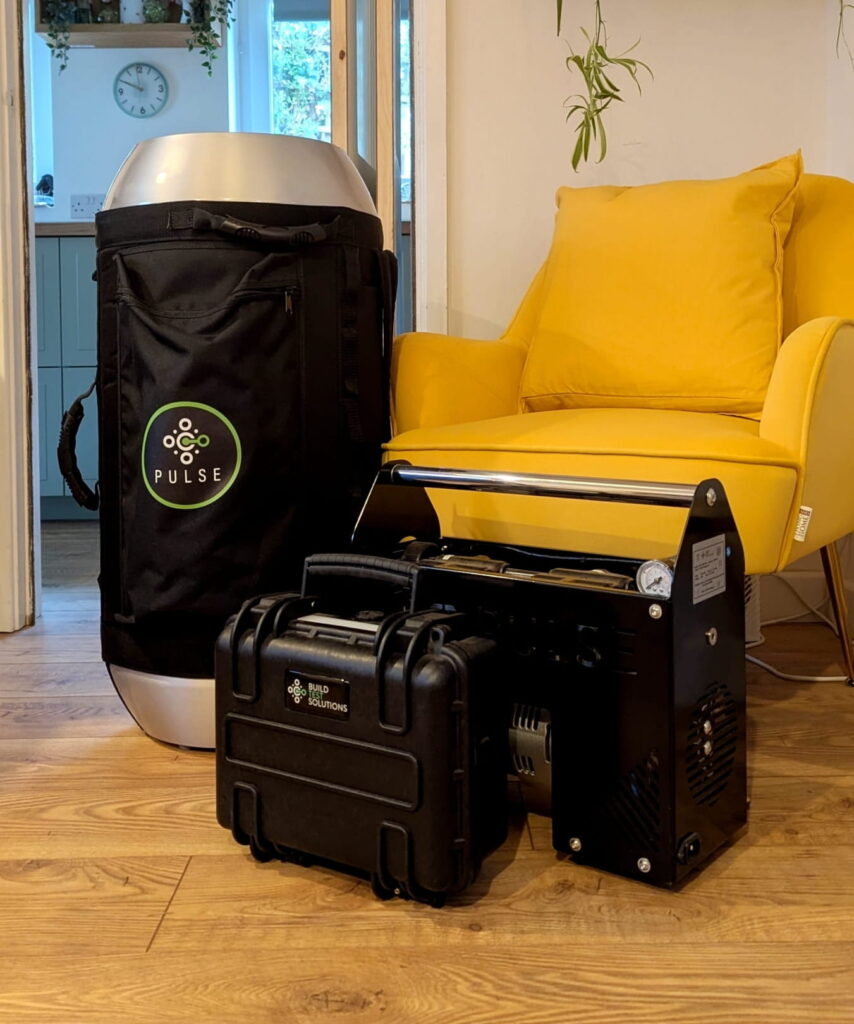
The test is done with Pulse 2.0 equipment, which uses a pressurised tank of air to let off 2-3 controlled releases or pulses, with a receiver measuring the effect on the internal air pressure. The test itself takes less than one minute. Before this, the surveyor needs to measure all rooms in the building with a laser measure to be able to calculate the building volume and envelope. These calculations are done off-site, to save time, and your results will be emailed to you.
Results will come in the form of ACH – Air Changes Per Hour, meaning how many times in one hour the quantity of air in the whole building is exchanged.
Pulse testing is:
- Non-invasive
- Fast and accurate
- Quantitative data
Why might I need a Background Ventilation Test?
Does your home feel cold and draughty but you are unsure how leaky it might be? Or maybe you suffer from mould and damp, or have concerns about CO2 or other air quality issues at home.
This test helps to determine if your home is under-ventilated (not enough fresh air), or too draughty (too much air and heat leakage). Without proper ventilation such as trickle vents, extractor fans, or whole house systems like MVHR, there can be poor air quality or risk of damp and mould. On the other end of the scale, too many draughts can cause heat loss, which can come at a cost to your health and heating bills.
A background ventilation test can inform retrofit works large and small, and can also help inform a landlord or housing authority to prioritise certain works.
Shouldn’t I get an airtightness test?
The CHEESE Project is able to offer certified Airtightness testing. Airtightness tests are more relevant for new builds and major retrofit or renovation projects where a professional or whole-house ventilation system is in place. They involve temporarily sealing off purpose-built ventilation, e.g., including extractor fans, cooker hoods, trickle vents on windows, chimney flues, and open plumbing waste pipes, with the aim of achieving the best possible test result for certification purposes.
You may also be interested in a certified airtightness test if you are specifically looking to improve your EPC.
For homes outside of new-builds, construction and ventilation can be so varied. To better understand your home and how you live, breathe, and heat it in regular use, a background ventilation test may be the best choice.
Watch how it works
Book a callback
Choose a convenient time for a call and we will take your details and book you in over the phone.